Stockwatch: what next for Nvidia minus its founder CEO?
A dramatic turnaround in fortunes threatens to unravel one of the tech sector’s biggest success stories. Analyst Edmond Jackson discusses whether the selling is overdone.
20th November 2026 11:21
by Edmond Jackson from interactive investor
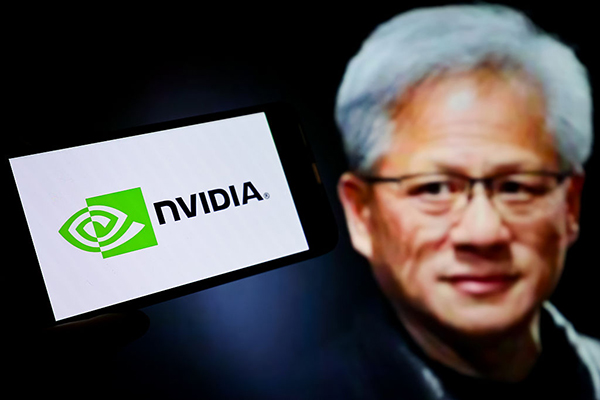
The Nvidia logo with a portrait of Jensen Huang in the background Photo: VCG/VCG via Getty Images.
A 40% fall in NVIDIA Corp (NASDAQ:NVDA) from an early October all-time high above $243 to about $145 now can seem an outstanding buying opportunity, given its global command of AI microchips and Tuesday night’s blistering third-quarter results that raised guidance for its January 2028 year. Yet the drift continues. Might it pay to be greedy while others are fearful?
- Invest with ii: Buy US Stocks from UK | Most-traded US Stocks | Cashback Offers
The chart implies a crucial test of an upward trend line as defined by a support level of $94 in April 2025:
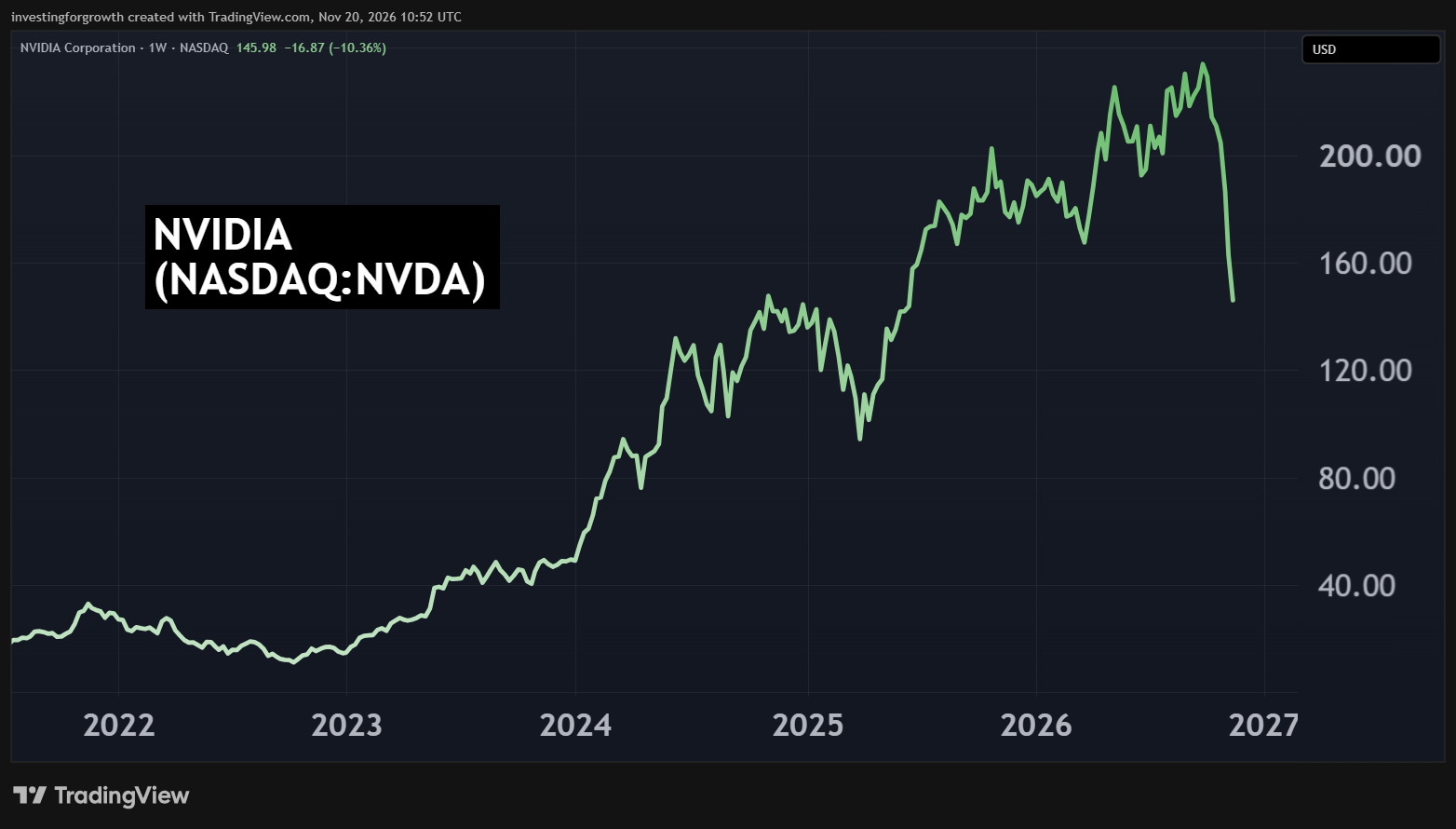
Source: TradingView. Past performance is not a guide to future performance.
Wresting for a long-term benchmark
When I drew attention to Nvidia as a “buy” as it tested $40 (adjusting for a 10-for-one stock split) in June 2023, I drew a parallel with ARM Holdings ADR (NASDAQ:ARM), which demerged from Acorn plc in 1998 and became a microchip behemoth for myriad devices, its shares rocketing 30x over two years. There appeared similar mass-market potential for Nvidia, which by mid-2023 had a similar 30% operating margin that I recalled for ARM Holdings.
Some 30 years later, ARM’s margin has eased to about 17% - still very good - yet Nvidia’s has been over 60% this year, rising to 67% in its third quarter.
Nvidia’s founding rationale in 1993 was that advancing demands on computer graphics would need a dedicated graphics processing unit (GPU) rather than just a central processing unit for operations. Having established itself as the premier GPU for gaming, it diversified into chips for high-performance computing and AI. This has resulted in a global market share of 75-85% in AI/GPU chips, which inevitably attracted competition, but which has yet to make a financial scratch according to Q3 numbers.
Given ARM went private from 2016 to 2023, a long-term chart is not feasible. However, comparing takeover, re-listing and recent market values, despite competition ARM has risen in value from about £1 billion in 1998 to near £150 billion equivalent now, having gone through four CEOs. It overcame a slump related to the 2000 tech crash and, in 2025, saw a 13% drop in market value to about £86 billion.
- Nvidia Q3: a welcome reprieve for its struggling shares
- 20 tech stocks ii investors are buying: week to 20 November 2026
- What to hold alongside a global tracker fund
Does ARM offer any reassurance to Nvidia investors, or is the comparison tenuous? Having originally met Robin Saxby - ARM’s founder CEO - for a day at its Cambridge base in 1999, the big difference even then was his having created a strong team with succession assured. Jensen Huang, Nvidia’s founder ex-CEO is a classic industry rock star, dressing his own way and having had some 60 executives report directly to him. Already, 20% of the workforce has signed a petition for his return, yet the board is emphatic about finding a successor. It seems entirely possible, he/she will change the top tier and, should Huang start his own venture, could suffer key talent ebb.
Historical ARM and present-day Nvidia are therefore a contrast in personnel situation. Could this be a deciding factor?
The dissonance to grasp can be summarised thus:
Bullishly: Nvidia has raised its revenue growth guidance for the next fiscal year from 70% to 75%, the backlog (work contracted for but yet to manifest in revenue) related to cloud alone, up 25% in just three months to $2.5 trillion (£1.9 trillion). This affirms AI infrastructure demand is still booming with Nvidia at its core.
NVIDIA Corp - third-quarter fiscal 2027
to 25 October
GAAP $ billion
| Q3 FY27 | Q2 FY27 | Q3 FY26 | Q/Q | Y/Y | |
| Revenue | 115.8 | 96.2 | 57.0 | 20% | 103% |
| Gross margin | 74.8% | 75.0% | 73.4% | -0.2 | 1.4 |
| Operating expenses | 9.2 | 8.4 | 5.8 | 9% | 57% |
| Operating income | 77.5 | 63.7 | 36.0 | 22% | 115% |
| Net income | 65.3 | 59.7 | 31.9 | 9% | 105% |
| Diluted earnings per share $ | 2.70 | 2.46 | 1.30 | 10% | 108% |
| Guidance for fourth quarter | Revenue of $130 billion, plus or minus 3% |
| fiscal 2027 | Gross margin of 71% to 72% |
| Operating expenses of $11 billion | |
| Full-year tax rate of 16% |
Source: Nvidia newsroom.
It implies momentum greatly in excess of a forward price/earnings (PE) ratio possibly as low as 10x, or a trailing PE around 20x. If you respect PEG (PE/growth) ratios, the PE relative to underlying growth is ludicrously low – in the region of 0.1 to 0.2 – when value is said to exist sub-1.0. That’s assuming any crisis for both American AI and Nvidia is averted.
Meanwhile, at around $183, ARM’s forward PE is more like 75x with a PEG roughly 2.0x – overvalued arithmetically just free of the fear factor that has enveloped Nvidia. The history of ARM’s PE actually saw it exceed 100x by early 2000, then decline to a 30-40x range in the years after that tech share bubble burst.
While ARM engages design licensing rather than manufacture, hence is a kind of toll road for data centres (having previously dominated smartphones), its PE still looks bubble-like and the company has significant AI exposure. Even so, ARM’s chart can look as if it has already mean-reverted:
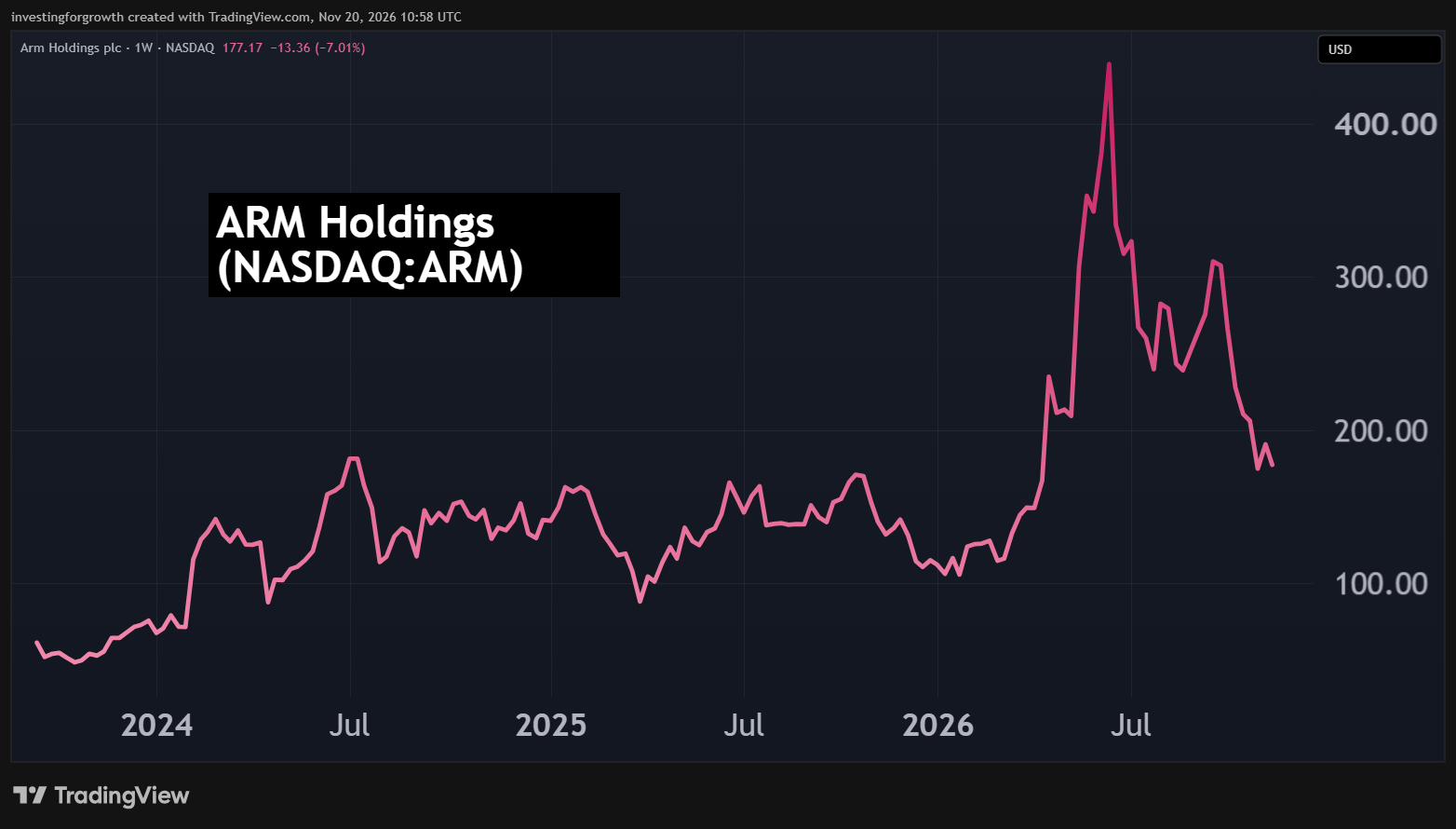
Source: TradingView. Past performance is not a guide to future performance.
Bearishly: AI valuations are faltering amid concern about whether a stampede of debt-driven US investment can prove justified. Certainly, Nvidia’s momentum will slow simply due to its scale, but will the boom deflate or will there be some kind of bust? Might China’s less capital-intensive AI development end up being superior and the global model to adopt?
Three hours before Nvidia’s earnings call, I was at a London lecture, The geopolitics and macrofinance of AI: a race between the US and China, during which the economics professor appeared more respectful of China’s approach given the high risks baked into US financing. But even they eschewed predictions.
Nvidia shares were falling before Huang’s departure
Nvidia’s share price had slid from over $240 in October to below $175 by 11 November, amid concerns that rising interest rates will affect debt-heavy AI infrastructure customers. The US midterm elections had also spurred Democrats attuned to voter resistance to data centres being developed locally.
Will AI financing prove stable relative to outcomes? Momentum was triggered by the Biden administration offering subsidies of up to 75% of development costs. Since the US approach is capital-thirsty, [for] “closed-model” proprietary AI (versus China’s “open-weight” AI that is publicly released) the current estimate is some $7.6 trillion financing being arranged from 2026-31.
- Investment trusts that have benefited from Anthropic IPO
- Experts predict another great year for stock markets in 2027
- Fund ideas for the ‘anti-AI’ investor
Bond issues have expanded rapidly from investment to junk grade, while pension funds have raised AI exposure, and Nvidia currently represents about 4% of total global equity value. Much is therefore at stake should the situation destabilise rather than consolidate.
By contrast, China’s AI spend is around a fifth of the US’ and more applied – such as robotics and autonomous systems.
Meanwhile, Washington is now on the case of Nvidia possibly having provided China with access to the most advanced chips via Southeast Asia. The US Department of Commerce acted swiftly on Monday, limiting other countries’ access. UBS estimates this could affect a tenth of Nvidia’s revenue.
Company-specific financing risks and Nvidia’s technology
Another reason for the share decline is concern about “circular financing” where Nvidia has helped customers buy its hardware. This became a hallmark of Huang’s leadership, with some $500 billion of such arrangements disclosed. For example, $105 billion in lease obligations for an OpenAI data centre in Ohio, and commitments of up to $100 billion in OpenAI, and $10 billion in Anthropic, PBC Ordinary Shares - Class A (NASDAQ:ANT), which subsequently committed to buying Nvidia chips.
Among higher-risk companies, Nvidia carries a $6.3 billion backstop with cloud company CoreWeave Inc Ordinary Shares - Class A (NASDAQ:CRWV) to April 2032, involving a promise to buy unsold capacity. Coreweave had $25 billion of debt and $4.7 billion negative free cash flow in its last quarter, its bonds yielding 16%.
Last August, Nvidia declared a $500 billion chip securitisation programme in which it would provide residual value support to customers covering up to a quarter of the deal, with funds to be disbursed from 2027.
I do not imply anything like the “round tripping” engaged by Autonomy Corporation as part of inflating revenue ahead of its $11 billion sale to Hewlett-Packard in 2011. Huang’s objective was to create a customer base outside of hyperscalers developing their own chips, which made good strategic sense.
However, the interim CEO has already altered terms such that supply commitments – for example to neocloud businesses – take effect only after such firms independently secure their own financing.
One analyst estimates neoclouds comprise a quarter of Nvidia’s revenue. Meanwhile, just over a half derives from a small group of hyperscalers. This suddenly all looks high risk if the neocloud-backed culture has ended and hyperscalers are on the cusp of doing their own thing.
Technically, simulations by analytical group Epoch AI have shown AMD’s latest chip outperforms Nvidia’s best in terms of simultaneous request capability. Alphabet Inc Class C (NASDAQ:GOOG), Amazon.com Inc (NASDAQ:AMZN) and Microsoft Corp (NASDAQ:MSFT) are all developing high-performance AI chips to reduce reliance on Nvidia.
Analyst consensus is overwhelmingly bullish
The average 12-month analyst target for Nvidia is $260 to $275, implying nearly 80% upside.
Mind you, consensus was similarly bullish on tech leaders at the start of 2000, with 85% of recommendations a “strong buy” and no “sell” stances. The AI sector eerily mirrors this with 83% a “strong buy” and 2% “sell”.
I think one definitely has to think freely as facts come to light.
- Ian Cowie: the US trust I’m backing amid AI turmoil
- Sign up to our free newsletter for investment ideas, latest news and award-winning analysis
- Where to find the best investment returns in 2027
The 2008 crisis was fuelled by hidden leverage, over-extended credit and interconnected balance sheets. It may be an exaggeration to suggest a repeat of the scale of “sub-prime”, but rapidity of AI financing begs more clarity. US banks are now exposed to near $1 trillion of AI-related loans.
Michael Burry, best-known for profiting from the 2008 US housing market crash, has disclosed put options on Nvidia with a $140 strike price expiring in February 2027 - his rationale significantly relating to AI infrastructure sustainability and customer finance arrangements. He also questions how Nvidia sales are reported by customer headquarters versus billing location.
Should you ‘fight the tape’?
Nvidia’s market price continues to erode despite a surge of retail investor buying after Huang departed. I would give things more time to settle, if indeed they do.
At some risk of over-thinking, multiple scenarios could apply here, for “sell” as well as “buy”.
On the bull tack, should a respected CEO be appointed – in suitable time to ensure the right person and thwart key talent loss – this would likely boost near-term sentiment. Further positive updates would help too.
A key political risk is Huang being scheduled to appear before three US House committees on 1 December. If that can go smoothly enough then fears may ebb, but if Nvidia has in any way dodged export restrictions then beware a US crackdown on tech, especially with US President Donald Trump now weakened.
The earnings call pronounced $227 billion committed for share buybacks by end-January 2028, which sounded like a prop, although it represents 6.4% of current market value. Other factors will be more significant.
A technical analysis perspective – the balance of buyers and sellers – could be your best near-term guide. If there is a buying opportunity, let it come to you. I adjust my view to “hold” pending more clarity.
Edmond Jackson is a freelance contributor and not a direct employee of interactive investor.
These articles are provided for information purposes only. Occasionally, an opinion about whether to buy or sell a specific investment may be provided by third parties. The content is not intended to be a personal recommendation to buy or sell any financial instrument or product, or to adopt any investment strategy as it is not provided based on an assessment of your investing knowledge and experience, your financial situation or your investment objectives. The value of your investments, and the income derived from them, may go down as well as up. You may not get back all the money that you invest. The investments referred to in this article may not be suitable for all investors, and if in doubt, an investor should seek advice from a qualified investment adviser.
Full performance can be found on the company or index summary page on the interactive investor website. Simply click on the company's or index name highlighted in the article.
Disclosure
We use a combination of fundamental and technical analysis in forming our view as to the valuation and prospects of an investment. Where relevant we have set out those particular matters we think are important in the above article, but further detail can be found here.
Please note that our article on this investment should not be considered to be a regular publication.
Details of all recommendations issued by ii during the previous 12-month period can be found here.
ii adheres to a strict code of conduct. Contributors may hold shares or have other interests in companies included in these portfolios, which could create a conflict of interests. Contributors intending to write about any financial instruments in which they have an interest are required to disclose such interest to ii and in the article itself. ii will at all times consider whether such interest impairs the objectivity of the recommendation.
In addition, individuals involved in the production of investment articles are subject to a personal account dealing restriction, which prevents them from placing a transaction in the specified instrument(s) for a period before and for five working days after such publication. This is to avoid personal interests conflicting with the interests of the recipients of those investment articles.